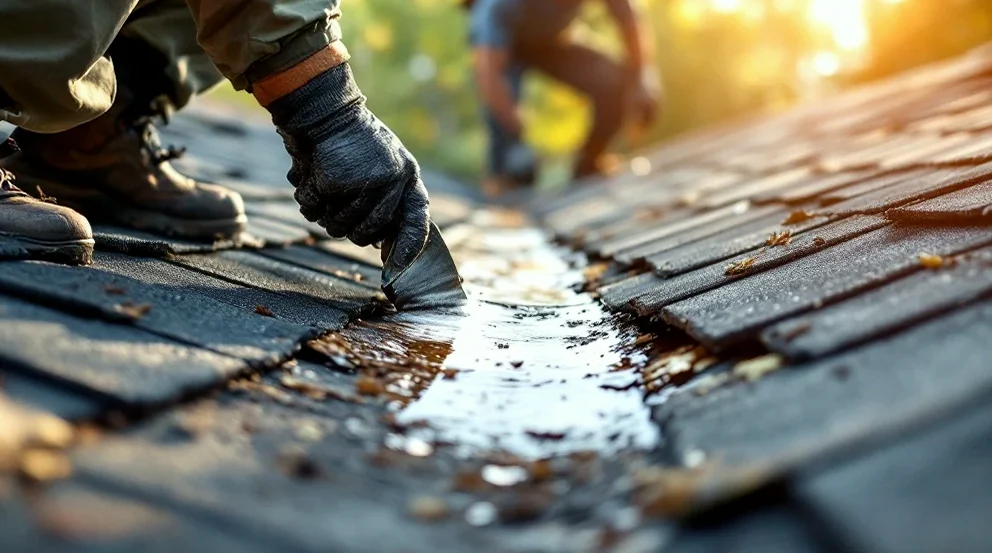
What is Shingle Roof Leak Repair and how does it work?
Shingle roof leak repair means finding the exact spot water is getting through your asphalt shingles and sealing it, instead of replacing the whole roof. It usually involves re-sealing or replacing flashing, patching shingles, or fixing a pipe boot. Most jobs take a few hours and cost between $150 and $3,000 in Birmingham. (birminghamroofco.com)
Water is sneaky. It almost never drips straight down through the shingle above your ceiling stain. It enters higher up, runs along the decking or a rafter, and shows up somewhere else. That's why a shingle repair starts with tracing the path, not just caulking the wet spot.
Asphalt shingles shed water as a system: overlapping courses, underlayment beneath them, and metal flashing at edges and penetrations. A leak means one part of that system failed. Repair restores that one part. Replacement tears off the whole system. For a single failure, repair is almost always the right call.
In Birmingham, most of our shingle leak calls come from three things: wind-driven rain pushing under lifted tabs, failed pipe boots, and flashing that's pulled loose at a chimney or wall. None of those require a new roof.
- Re-sealing or replacing step flashing at walls and chimneys
- Swapping cracked pipe boots around plumbing vents
- Re-nailing or replacing lifted, torn, or missing shingles
- Clearing debris dams at valleys and behind chimneys
Short version
- Leaks start uphill from the stain; we trace the water path first.
- Most shingle repairs take 2 to 4 hours and cost $400 to $1,500. (birminghamroofco.com)
- A repair is a fraction of a full replacement, which runs $8,000 to $15,000 for architectural shingles on a 2,000 sq ft home. (ridgelineconstructionhsv.com)
- We give you a written scope and photos before we start.
How Shingle Roof Leak Repair works, start to finish
A shingle repair runs in four stages: find the entry point, prep the area, fix the failed component, and test it. Finding the entry point is the hard part. Fixing it is usually quick. Most jobs are done the same day.
We start by walking the roof and looking uphill from where you see the stain. Water follows gravity and the path of least resistance, so the entry point is often 5 to 15 feet above the drip. On a two-story home in Crestwood or Homewood, that means checking the valley above the stain, any pipe boots in line with it, and the chimney flashing.
Then we check the attic if it's accessible. Stains on rafters, wet insulation, or dark streaks on the underside of the decking tell us which way the water is traveling. A $20 flashlight and five minutes in the attic often saves an hour on the roof.
Once we've got the spot, we prep it. That means pulling the shingles back carefully, not prying them up and cracking them. Asphalt shingles get brittle in Birmingham heat, and a careless pry bar turns a one-shingle repair into a five-shingle repair.
The fix itself depends on what failed. Pipe boot: cut the old rubber collar off, slide a new boot over the pipe, nail it, seal it. Step flashing: tuck new metal under the siding and over the shingle course. Lifted shingles: re-nail with roofing nails and seal the tabs with roofing cement. Valley: clear debris and re-seal or replace the valley metal.
Finally, we test. If it's safe, we run a hose on the repaired area for 10 to 15 minutes while someone watches inside. If it's not safe to get on the roof with water running, we wait for the next hard rain and check. We also photograph the repair and send you the photos.
- Trace the leak.Walk the roof above the stain, check the attic, and follow the water path back to its entry point.
- Prep the area.Gently lift shingles, remove failed sealant, and clear debris so new materials sit flat.
- Fix the failure.Replace the pipe boot, flashing, or shingles that failed, using materials matched to your existing roof.
- Test and document.Hose-test or wait for rain, then send you photos of the finished repair.
Why Shingle Roof Leak Repair matters for your home
A small shingle leak can rot decking, soak insulation, and stain ceilings within a few months. Repairing it early keeps the damage contained and keeps you out of a full replacement. In Birmingham, where we get 55-plus inches of rain a year, small leaks get worse fast.
Water that gets past the shingles doesn't just drip. It soaks into the wood decking, the insulation, and sometimes the drywall. Wet insulation stops insulating, which shows up as higher power bills. Wet decking rots, and rotted decking can't hold nails, so the next windstorm peels more shingles.
Mold is the other shoe. Birmingham's humidity means a wet attic stays wet. Within a few weeks, you can have mold on the rafters and a musty smell in the house. Mold remediation costs more than most roof repairs.
Catching it early is the whole game. A $400 to $1,500 shingle repair now versus a replacement that starts around $8,000 for 3-tab and runs $8,600 to $15,000 for architectural shingles on a typical Birmingham home. (greenvalleyroofers.com) The math isn't close.
There's also the resale angle. A Birmingham buyer's inspector will find an active leak. A documented repair with photos is a non-issue. An unrepaired leak is a negotiation chip the buyer will use.
Worth repairing when
- Roof is under 15 years old and the shingles are mostly intact
- A leak traces to one component: a boot, a flashing, a valley
- You see a single stain or a small area of damage
- Decking under the leak is still solid
Consider replacement when
- Shingles are curling, cracking, or losing granules across the whole roof
- You have multiple leaks in different areas
- Decking is soft or rotted over a large area
- Roof is 20-plus years old and already near end of life
Common problems and what causes them
Five failures cause most shingle leaks in Birmingham: pipe boots, flashing, wind-lifted shingles, debris dams, and hail or storm damage. Each has a different fix and a different price range.
Pipe boots are the number one culprit. The rubber collar around a plumbing vent cracks after 8 to 12 years of Alabama sun. Once it cracks, water runs straight down the pipe and into your ceiling. A new boot is one of the cheapest repairs we do, usually on the low end of the $225 to $550 small-repair range. (onecallroofing.com)
Flashing failures come next. Chimney flashing, step flashing where a roof meets a wall, and valley metal all rely on sealant that dries out and cracks. Wind-driven rain during a Birmingham thunderstorm finds those cracks. Re-flashing is a mid-range repair, often in the $1,075 to $1,825 band for larger jobs. (onecallroofing.com)
Wind-lifted shingles are common after spring storms. A lifted tab isn't a leak yet, but the next rain pushes water under it. If you see shingles flipped up or granules in your gutters after a storm, get it looked at before the next front moves through.
Debris dams form behind chimneys, in valleys, and at the bottom of roof-to-wall intersections. Pine straw, leaves, and shingle granules pile up and hold water against the shingles. Over a season or two, that water works its way under the tabs. Clearing debris is part of most repairs we do.
Hail and storm damage is the wildcard. Hail bruises shingles, knocking granules loose and exposing the asphalt. You may not see a leak for months, then a hard rain finds the bruise. If a storm rolled through your neighborhood, it's worth a look even if nothing's leaking yet.
Water actively dripping inside
Shut off the area, put a bucket down, and call us. Active leaks spread fast and can hit wiring or insulation.
Ceiling stain, no active drip
The leak is slow but it is not going away. Book a repair within a week or two before the next heavy rain.
Lifted shingles or granules in gutters
Not leaking yet, but the next storm may change that. Have it checked during a routine visit.
What shingle roof leak repair costs in Birmingham
Shingle roof leak repairs in Birmingham run $150 to $3,000, with most jobs landing between $400 and $1,500. (birminghamroofco.com) Small fixes like a pipe boot or a few shingles are usually $225 to $550. (onecallroofing.com) Larger repairs involving flashing or valleys run $1,075 to $1,825. (onecallroofing.com)
What pushes you toward the top of the range: a steep roof, a two-story home, a leak that requires pulling up a lot of shingles to reach, or damage that turns out to include rotted decking. What keeps you at the bottom: a single pipe boot, a small flashing reseal, or a handful of nails and sealant.
The cheapest repairs, $150 to $1,500, are usually done in hours or the same day. (patriotroofingbirmingham.com) That covers the vast majority of shingle leaks we see.
Compare that to replacement. A standard architectural shingle replacement on a 2,000 sq ft Alabama home runs $8,000 to $15,000. (ridgelineconstructionhsv.com) In Birmingham specifically, 3-tab replacement averages $8,000 to $10,000, and architectural shingles run $8,600 to $15,000. (greenvalleyroofers.com)
These are typical ranges, not quotes. The only way to know your number is an on-site look. We don't charge for that, and we don't pressure you into a replacement you don't need.
If the leak traces to one component and the rest of the roof is sound, repair it. If shingles are failing across the roof, replacement is the better long-term spend.
Can you repair a shingle leak yourself?
You can handle a few shingle repairs yourself: sealing a small crack, replacing a pipe boot, or re-nailing a lifted tab. Anything involving flashing, valleys, or walking a steep roof is worth paying for. The risk isn't the repair, it's the fall and the misdiagnosis.
Birmingham roofs get hot. Surface temps hit 140 degrees or more in July and August. That's a bad combination with a ladder, and it's why most DIY shingle repairs happen in the morning or on a cool day.
The other issue is diagnosis. If you seal the wrong spot, you've spent a Saturday and the leak is still there. Water travels. We've seen leaks where the stain was in the hallway and the entry point was 12 feet away at a pipe boot on the back slope.
If you do want to try it, the safe DIY jobs are: re-sealing a pipe boot collar with roofing cement, replacing a cracked boot with a new one, and re-nailing a lifted shingle tab. Use roofing cement, not silicone. Silicone doesn't stick to asphalt shingles long-term.
Leave alone anything that requires lifting more than a couple of shingles, walking a roof steeper than 6/12, or working around a chimney. That's where mistakes get expensive.
- Safe DIY: pipe boot reseal, single shingle replacement, lifted tab re-nail
- Call us: chimney flashing, valley repair, step flashing, anything over a two-story drop
- Never: walk a wet roof, work alone on a steep pitch, or use silicone on shingles
How to pick who fixes your shingle leak
Ask three things before you hire anyone: do they walk the roof and check the attic, do they give you a written scope with photos, and do they warranty the repair. If any answer is no, keep looking.
A proper shingle repair starts with a roof walk and, if possible, an attic check. Anyone who quotes from the driveway is guessing. Water paths aren't visible from the ground.
Ask for a written scope. It should name the specific failure (pipe boot, step flashing, valley metal) and the specific fix. Vague scopes like "repair leak" leave room for a bigger bill later.
Warranty matters. A repair that fails in six months should be covered. We warranty our shingle repairs for a year, and we come back if the same spot leaks.
Watch out for the storm-chaser pitch. After a big hail event, out-of-town crews show up in Birmingham, knock doors, and offer free inspections that always end in a full replacement. Some are legitimate. Many aren't. If they want a signed contract on the first visit, walk away.
If the quote comes from the driveway, it's a guess. Water paths aren't visible from the ground.
Frequently Asked Questions
How much does shingle roof leak repair cost in Birmingham?
Repairs run $150 to $3,000, with most jobs between $400 and $1,500. (birminghamroofco.com) Small fixes like a pipe boot or a few shingles are $225 to $550. (onecallroofing.com) Larger jobs involving flashing or valleys run $1,075 to $1,825. (onecallroofing.com) The exact number depends on roof pitch, height, and how much damage we find once we're up there.
Can you repair a shingle roof leak without replacing the roof?
Yes, and that's the usual case. If the leak traces to one component like a pipe boot or a piece of flashing, we fix that component and leave the rest of the roof alone. Replacement only makes sense when shingles are failing across the whole roof or the decking is rotted over a large area.
How long does a shingle roof leak repair take?
Most repairs take two to four hours. Small jobs like a pipe boot swap are often done in under two hours. If we have to pull up several courses of shingles to reach flashing, it can stretch to a full day. We tell you the expected time before we start.
Will homeowners insurance cover shingle roof leak repair?
It depends on the cause. Sudden damage from wind, hail, or a fallen limb is usually covered. Leaks from age, wear, or lack of maintenance usually aren't. Your deductible matters. If the repair is under your deductible, filing a claim doesn't help. We can document the damage so you have what you need to file if it's worth it.
How do I find where my shingle roof is leaking?
Start in the attic on a rainy day. Look for wet decking, dark streaks on rafters, or dripping. The entry point is usually uphill from where you see the stain, often 5 to 15 feet away. If you can't find it, we trace it from the roof with a hose test.
Can I repair a shingle roof leak myself?
Small jobs, yes. Re-sealing a pipe boot, replacing a cracked boot, or re-nailing a lifted tab are doable if you're comfortable on a roof. Anything involving flashing, valleys, or a steep pitch is worth paying for. The risk isn't the repair cost, it's a fall or a misdiagnosis that leaves the leak running.
How long does a shingle roof repair last?
A properly done repair lasts as long as the surrounding roof, often 10 to 15 years. The catch is the shingles around it. If they're near end of life, the repair outlasts them and you're back to replacement sooner than you'd like. We'll tell you straight if that's the situation.
What's the best time of year to repair a shingle roof in Birmingham?
Spring and fall are easiest on the crew and the shingles. Summer works, but we start early to beat the heat. Winter is fine too; asphalt shingles seal better above 40 degrees, so we may wait for a warm afternoon if it's cold. Leaks don't wait, so we handle active leaks year-round.
Do you offer emergency shingle roof leak repair?
Yes. If water is actively coming into your home, call us. We'll get someone out to stop the water, even if the permanent repair has to wait for dry weather. Emergency tarping and temporary sealing are part of what we do.
How do I know if my shingle roof needs repair or full replacement?
Age and extent of damage are the two factors. Under 15 years old with one leak, repair. Over 20 years old with shingles curling, cracking, or losing granules across the roof, replacement. Multiple leaks in different areas also point toward replacement. We'll give you both numbers and let you decide.
Sources
Need roof leak repair in Birmingham? Get a free estimate today.
📞 256-363-5379